
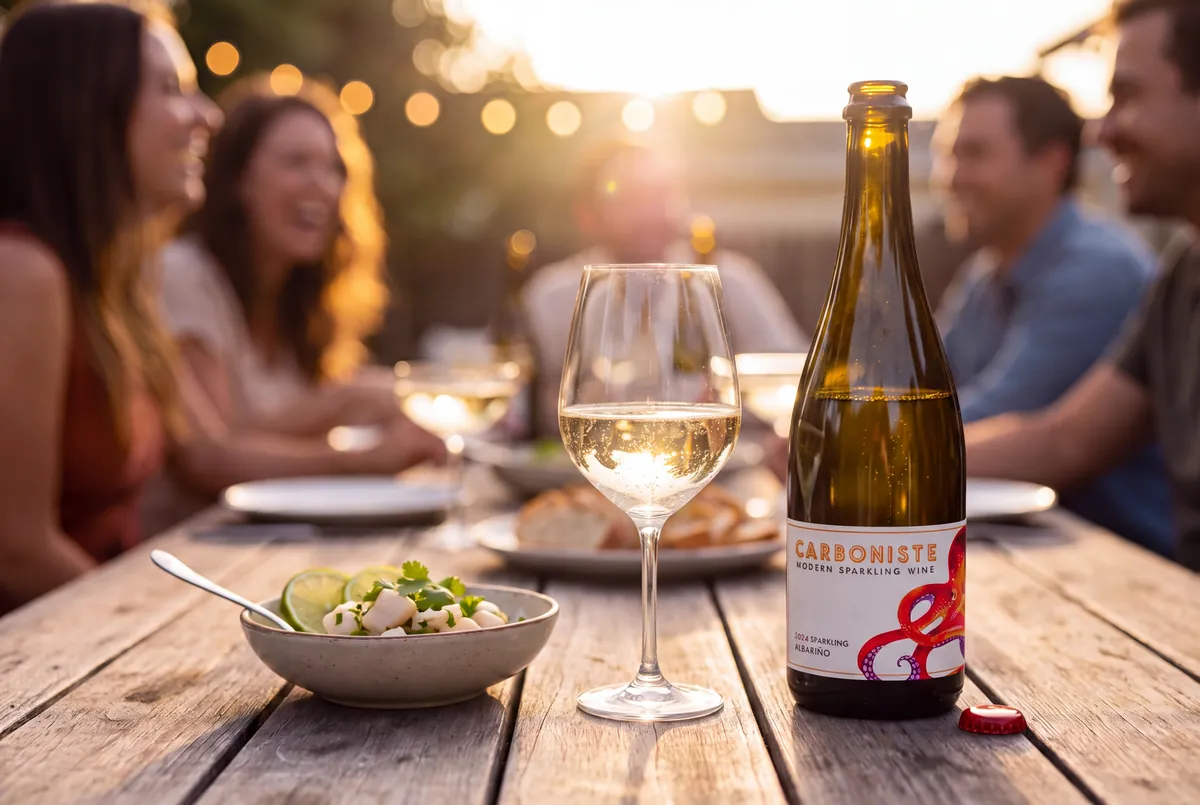
The short answer: sparkling Albariño is wine made from the Albariño grape and given bubbles. Ours, the Octopus, is made in the traditional method: two fermentations, the second one in the bottle. Albariño holds onto bright acidity even in warm places and tastes juicy and fresh, which makes it a natural fit for California sparkling wine. It was the first wine we ever made at Carboniste, and it’s still our flagship.
Why start a sparkling wine company with Albariño?
It was very intentional. If you’re going to build a sparkling wine brand, something that’s hard to do, and pour your own time, money and passion into it, you’d better pick the right first wine.
Two things pointed the way. Jacqueline, my partner and co-founder, was sourcing fruit in Lodi through Markus Bokisch, the grower who really brought Albariño to California. He recommended a fantastic Albariño from Gomes Vineyard in the Sacramento Delta. Jacqueline made a still wine from it, and when she brought it home, I thought, wow, this is really delicious Albariño. Around the same time, we went to Porto to visit a friend I went to school with who works in the Portuguese wine industry. We tasted a bunch of wines, including some delicious sparkling Albariños, and I came home with a conviction: this is what we should do.
It also fit my thesis about California sparkling wine. Champagne is a place in France, so we shouldn’t make Champagne here. The question is what makes sense to make here, and to me the answer is a wine that’s truly expressive of California sunshine. That’s our terroir. Even in October it can be 95 degrees and sunny here, hot enough that my skin is hot just from walking around outside, and I love that about this place. But it also means you can’t make Champagne in California, because the grapes taste different. They taste like sunshine.
Albariño fits that perfectly. It’s a high-acid grape, so it holds its acidity nicely even in a warmer region, and the fruit is juicy and fresh. When you drink the wine, it tastes like the grape pops in your mouth. Pinot Noir and Chardonnay, the grapes that make Champagne, give rich, layered wines, and they can be beautiful. Albariño goes another way. Albariño is sunshine, it’s juice, it’s pure pleasure.
The first Octopus
The first vintage was 2017, and it was small on purpose: two tons of Albariño, as much as Jackie would let me get. That was as much money as she’d let me spend on what was really a pilot study: does this make sense, should we be making this wine at all?
Two tons made about a hundred cases, and we did every step by hand. The wine fermented in a small tank. I bottled it by hand, disgorged it by hand, hand-washed the bottles and hand-labeled them. Then I went door to door to restaurants to sell it. Everybody loved it, so we made more.
Where the Octopus grows
The Octopus comes from Gomes Vineyard on Andrus Island in the Sacramento River Delta, the same fruit that first won Jacqueline over. Markus Bokisch planted the vineyard with an Albariño clone he brought over from Spain, and the Gomes family, whose roots are in Portugal, farms it. Portugal also happens to be Albariño’s other home, where it goes by Alvarinho. I don’t know whether that’s why the family grows it. It was a happy coincidence for us.
More on the vineyard itself is in my Gomes Vineyard post.
I didn’t choose the site for a famous name on the label. I think it’s important not to go into winemaking with preconceptions about what makes a good wine. I don’t want to seek out the expensive appellation and assume it’s going to make the best wine. We need to find the sites that truly express the grape. California is the brand here, and for our Albariño, the Delta is that site.
How we make it
The Octopus is all about freshness, so everything we do protects it:
- Picking: early, usually in the first or second week of August. California ripens fast, so there isn’t much wiggle room. Pick too late and the wine carries too much alcohol; pick too early and it’s too sharp. We’re balancing the two.
- Fermentation: native yeast, in stainless steel rather than barrels.
- Malolactic: we try to keep the wine from going through malolactic conversion, so it holds its crisp acidity. It sometimes happens on its own anyway. When it does, the wine is a little less juicy, but it’s still good, and we still enjoy making it and drinking it.
- Short aging: a short rest before bottling, then about three months in the bottle. That gives the yeast enough time to eat their lunch, finish all the sugar, and run out, so we can safely riddle and disgorge.
- Finish: hand disgorged and sealed with a crown cap.
What sparkling Albariño tastes like
Think of an apricot that isn’t quite ripe. I always describe a stone fruit quality that’s decidedly fresh and youthful, more slightly crunchy apricot than a juicy, ripe peach that makes a mess. That crunch isn’t about acidity. It’s about where the fruit flavors sit on the ripeness spectrum: the fresh, tense end. Around it you’ll find lime, Meyer lemon, white flowers and a little jasmine.
What to eat with it
Fresh food, and fresh fish above all. Ceviche is a natural, and the bright citrus, crunch and acidity line up perfectly. If you want to show off, make it a scallop ceviche. Both the sweetness and the texture of the scallop work with the wine. The Octopus is also great with grilled octopus, if you’d like to keep things in the family.
My own go-to is simpler: plain potato chips. They’re salty and crunchy, and there’s a kind of purity to them. Sparkling wine is a delicate style, and you don’t want food with so much flavor that it takes over. Plain chips won’t fight the wine. They just give your palate a little satisfaction and a little salivation, and keep it moving and fresh.
And an Octopus night at our house? You get home from work, pull a bottle out of the fridge, and start making dinner with your partner, talking about the rest of the week or the weekend. Then you sit down with just enough wine for dinner, because you’ve drunk most of the bottle while you were cooking.
The one thing to remember: it tastes like California sunshine.
Quick answers
Is Albariño a sweet wine? No. Albariño is known for bright acidity, and the Octopus drinks crisp and fresh.
Where is Albariño from? It’s at home in northwest Spain (Rías Baixas) and northern Portugal (Vinho Verde, where it’s called Alvarinho). Ours grows in California’s Sacramento River Delta.
When was the first Octopus made? In 2017: two tons of Albariño, about a hundred cases, all made by hand.
How is sparkling Albariño made? Ours uses the traditional method, with a second fermentation in the bottle. Here’s the whole process, start to finish.