
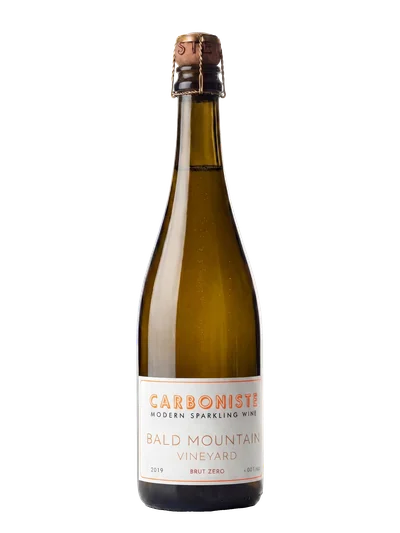
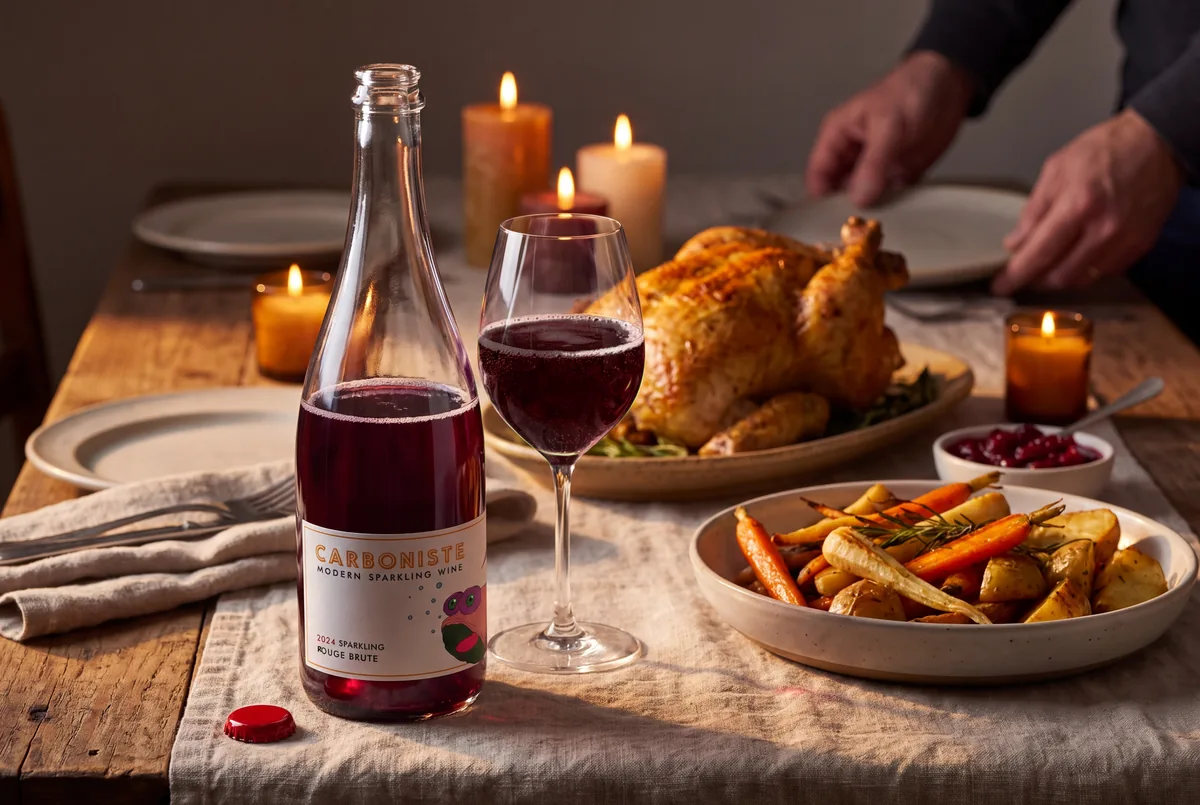
The short answer: sparkling red wine is red wine with bubbles: fruity, a little tannic and lively, best served cool. It’s still rare in California, and nobody quite agrees on how to make it. Ours, the Rouge Brute, started as an experiment on our Thanksgiving table in 2019. It’s juicy and fresh, a natural with burgers, pizza and the holiday table. Winemaker and co-founder Dan Person’s advice to anyone who’s never tried one: “Don’t be afraid of sparkling red wine.”
A Thanksgiving experiment
In 2019, Dan had made a little young Merlot for his father-in-law to give his friends at Christmas. At Thanksgiving they were tasting it, and a bottle of our sparkling Albariño, the Octopus, was on the table too.
“I had this sort of thought that it would go well with our sparkling Albariño,” Dan says. “So I blended the two together on the Thanksgiving dinner table, and they worked great, and that’s what we drank for the rest of the weekend.”
That became the first Rouge Brute, the same year. We had one keg of Merlot to work with, so the blend was about 30% Merlot and 70% Albariño, “about as much wine as I could possibly make.” It came to about 42 cases. “It was a tiny production, but it was delicious, and we knew we would want to make more.”
Following his gut
Dan came to sparkling red with no rulebook. “I didn’t have a lot of background in sparkling red prior to making this one, so I feel like I really came in as an uninitiated,” he says. “I didn’t have a real strong sense of how to make it or what it should taste like. But I knew I wanted to follow my gut.”
Merlot and Albariño were the foundation. The Merlot brings “a nice sort of plummy red fruit and dried mountain herbs,” with tannin and the fruit concentration that comes from fermenting on skins. The Albariño “is there to kind of lighten and brighten,” bringing back acidity and juiciness. That herbal edge reminded Dan of an Italian aperitif.
In the end, he says, it’s what he always wanted from a Lambrusco: “There’s some sweetness and some red fruit, some brightness and freshness, but it’s not bitter, it’s not heavy, and it’s not overly sweet and over-made.”
What’s in the bottle now
The blend changes a little every year as Dan works with what each vintage gives him. The 2024 label lists 35% Primitivo, 25% Merlot, 20% Gamay Noir and 20% Albariño. It gets 7 grams per liter of dosage, the most of any of our wines, set by taste so you never notice the sugar. (More on that in our guide to dosage.)
Our reds go into the tank as whole clusters, stems and all, with the berries unbroken. The grapes start to ferment from the inside, a process called carbonic maceration. “The grapes are not dead,” Dan says. “I just think of them as removed from the vine.” It makes fresher, lighter reds, with less tannin, a little less color, and a herbal lift from the stems. “I’m not trying to create a big massive wine,” he says. “I want the wines to be light and fresh and bright.” One experiment, a carbonic Primitivo from 2023, came out tasting like “super blood orange,” and all of it went into the Rouge Brute.
The mullet wine
Dan’s favorite description is his own: it’s a mullet wine. “Business in the front, party in the back,” he says. “It’s like red wine up front, but juicy and fun and bright in the back.”
Why “Rouge Brute”?
“It’s a play on words,” Dan says. “If this were French wine, this would be Brut Rouge. But this is not French wine, this is California wine.” So it’s a red brute, a red beast. Sparkling wine with tannin is unusual. “It’s a strange creature for a sparkling wine.”
The mudskipper
The critter on the label started as a clay sculpture Jacqueline, Dan’s partner and co-founder, made in grade school. It sat on her parents’ mantel for about 20 years before Dan had an artist draw it for the label. Jacqueline wasn’t sold. “She felt like it was an ugly sculpture, the product of a child’s imagination,” Dan says. “It wasn’t high art.”
Dan disagreed, and the sculpture turned out to look a lot like a mudskipper, a fish that can walk on land. “It’s a sort of transition fish, from aquatic to terrestrial,” Dan says, “and this is a transitioning wine that goes from sparkling wine to red wine.” The wine isn’t meant to be fancy either. “The wine is meant to be delicious and entertaining,” he says, “and the piece of art she made is the same thing, but in its sculpture form.”
Is sparkling red a Thanksgiving wine?
Yes. “It is a really good Thanksgiving wine, because it’s got a bit of tannin to help handle the fat of the dishes,” Dan says. “It works great on a table.” The acid and tannin together cut through rich food, which is why it’s just as good with a burger and fries or a pizza.
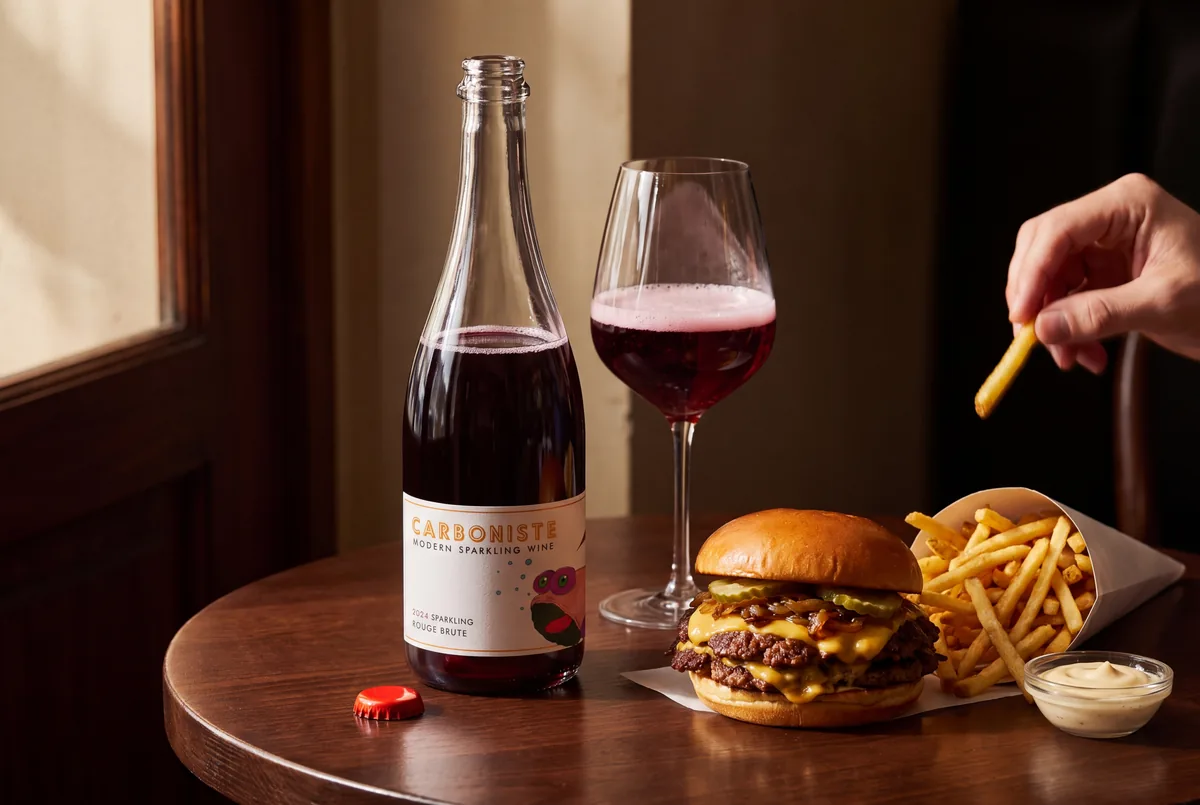
Serve it cool, not ice cold. The label says “chill me, crunchy red!” Dan’s rule for all our wines is somewhere between fridge and cellar temperature: “Keep it in the fridge, take it out, and then it warms up on its own while you’re drinking it.”
The first sip
“Sparkling red wine is a special experience for a first-timer,” Dan says. “You’re not really sure what you’re going to get into, but once you try it, it blows your mind. You’re like, ‘Wow, this is really cool. This is different.’ It’s like having wine for the first time.”
The one thing he wants you to remember: “If you’ve never had it before, this is a wine that’s easy to love, easy to drink, and worth checking out.”
Quick answers
What is sparkling red wine? Red wine with bubbles. Styles range from sweet to dry; ours is dry, light and juicy, made by the traditional method with a second fermentation in the bottle.
Is sparkling red wine good for Thanksgiving? Yes. Its acidity and gentle tannin handle rich, fatty dishes, and it suits a crowded table.
Should you chill sparkling red wine? Yes, lightly. Take it from the fridge and let it warm a little as you drink.
What food goes with sparkling red wine? Thanksgiving dinner, burgers and fries, pizza: anything rich enough to want something fresh alongside it.