
The short answer: native fermentation means we don’t add yeast to start our wines. The wild yeast that come in on the grapes and live in the winery do the work, and the result is more complex than a wine started from a packet. Malolactic conversion is a second, natural change that softens a wine’s sharpest acid and makes it stable. We let both happen in nearly every wine, because our whole approach is to work with what the grapes want to do.
What native fermentation means
Grape juice wants to become wine. Yeast is everywhere in a vineyard and a winery, and given time, it finds the juice. At Carboniste, after the grapes are pressed, we chill the juice for a day or two, draw it off its heavy sediment, and let it start on its own.
“It starts slower, and different yeasts propagate through fermentation, giving complexity,” says winemaker and co-founder Dan Person. Instead of one strain doing all the work, a whole succession of yeast take turns. “Inoculating from the beginning tends to make a simpler wine.”
How Dan settled on it
Dan learned to make traditional-method sparkling wine at Schramsberg, one of California’s most established sparkling houses. When we started Carboniste, he had to decide for himself whether native fermentation belonged in sparkling wine. So he tested it from our very first harvest. “Some of them I inoculated with commercial yeast, and other ones I left to go native,” he says. “Consistently I’ve preferred the complexity that we got from native fermentations.”
Native fermentation is, as he points out, “obviously the oldest technique for making wine, just allowing juice to convert into wine.”
The risks, and how we manage them
Wild yeast isn’t risk-free. With wines that are low in acid, Dan says, “you’re inviting a broader diversity of microbes,” and some of them you don’t want. Sparkling wine works in our favor here. Its base wines are high in acid, and that naturally keeps the troublemakers in check. “With sparkling wine, generally low pH and high acid, I’ve found fairly good success,” he says.
Sometimes a ferment starts slowly, or the yeast aren’t strong enough to finish. “That’s the job of the winemaker to manage those things,” Dan says. In those exceptional cases during harvest, we do add yeast.
Why the bottle gets a commercial yeast
Our second fermentation, the one in the bottle that makes the bubbles, always uses a commercial strain. Restarting fermentation in a finished wine, sealed in a bottle, is a much harder job, and native yeast can’t do it reliably. Dan explains this one in our post on the two yeasts in every bottle.
What malolactic does
Grapes carry two main things that microbes like to eat: sugar and malic acid, the sharp, green-apple acid. Yeast eat the sugar. Then, in malolactic conversion, natural bacteria turn the malic acid into softer lactic acid.
Once both are done, the wine is stable. “There’s no other large macro food that microbes can consume,” Dan says. That matters a great deal for a wine that’s going into a sealed bottle. If sugar or malic acid were left behind, something might start fermenting later in the bottle and leave off flavors you’d never want. A stable wine also means we don’t have to filter it before bottling. “If I can bottle without filtration, that’s going to be better for the wine quality,” Dan says.
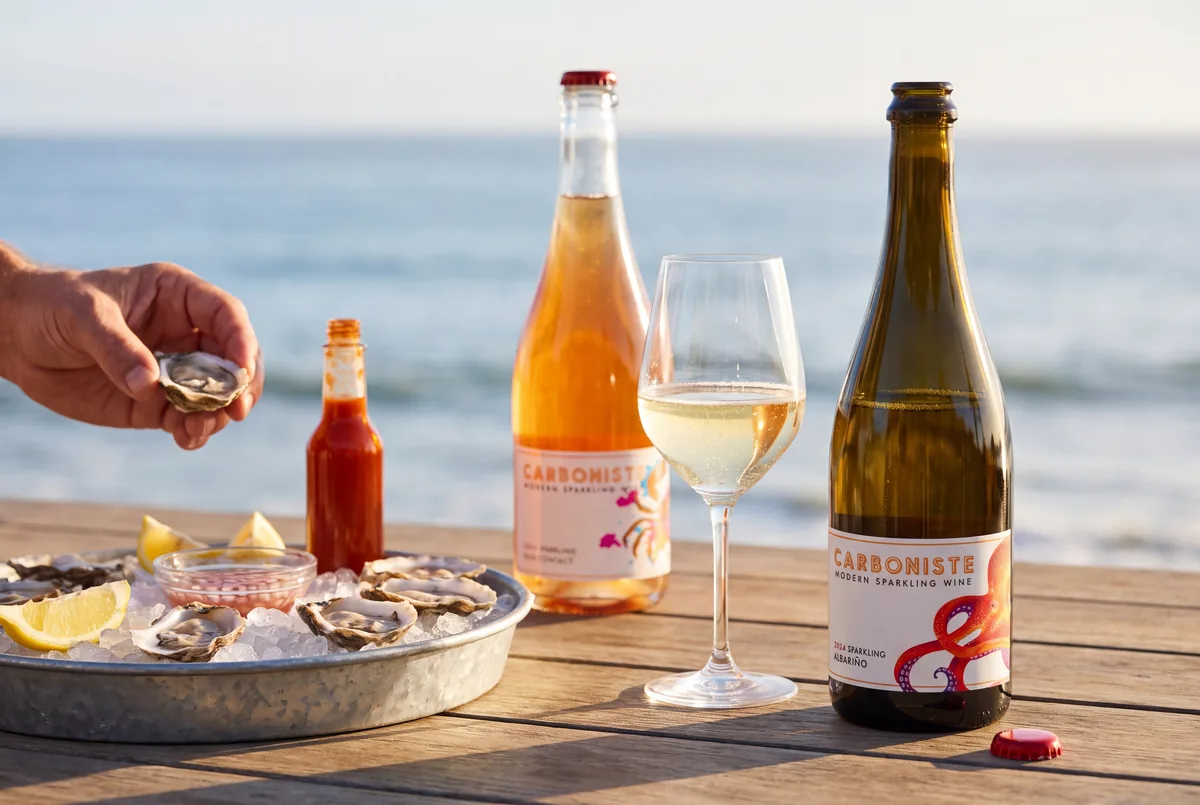
So almost all of our wines go through malolactic, naturally. The exception is the Octopus, our sparkling Albariño. In the Albariño, malolactic takes away acidity and brings “a not quite butteriness, but a richness” that dulls the bright fruit we want. We discourage it there. Even so, because we use so little sulfur, a little malolactic sometimes happens on its own. The wine is a little less juicy, Dan says, but still good.
Does malolactic mean a wine needs less dosage at the end? Sometimes. Lower acid can mean less sugar is needed for balance, but Dan tastes every wine on its own. (More on that in our guide to dosage.)
Low-resistance winemaking
Behind all of this is the idea Dan calls low-resistance winemaking. It comes from The One-Straw Revolution, a book by the Japanese farmer Masanobu Fukuoka about working with nature instead of against it.
“Human effort is waste,” is how Dan sums up the idea. “If we can align our work with the way that nature wants to work, the way that nature would normally progress, then we’re not forcing wine to do anything. We’re not forcing the juice or the grapes. We’re allowing the grapes to turn into wine.” And he thinks the wines are better for it: “more interesting, complex, compelling wines than starting out with grapes and trying to tell the grapes what they should taste like.”
That’s also why Dan wants “wines that taste like grapes,” and why he doesn’t decide in advance what a wine will taste like. “I discover the wines, not define them before they’re made,” he says.
Where we step in
Low resistance doesn’t mean no effort. We step in where the wine needs us:
- In the bottle, with a commercial yeast, because the second fermentation has to finish completely and safely.
- When a ferment stalls at harvest, with added yeast.
- When a barrel needs protection, with sulfur. Our long-aged barrels often go without added sulfur, but we watch them closely and add it if they start to drift.
- For clean bottles, with a mineral riddling aid that helps the yeast slide out at disgorging.
The rest of the time, we try to stay out of the way.
The one thing to remember
“Native fermentations can bring beautiful complexity of flavor,” Dan says, “but when you need to be sure something will ferment, inoculated yeast is more consistent and reliable.” We use each where it does the most good.
What to open
Dan’s pick is the Crab, our sparkling orange wine. “It’s a native fermentation with lots of complexity,” he says, “but we finish with conventional yeast for bottle fermentation.” Both halves of this post in one bottle.
Quick answers
What is native fermentation? Letting the wild yeast already present on the grapes and in the winery ferment the juice, instead of adding a commercial yeast.
Is native fermentation risky? It can be, especially with low-acid wines. Sparkling base wines are high in acid, which helps, and a winemaker can add yeast if a ferment stalls.
What does malolactic fermentation do? Natural bacteria turn sharp malic acid into softer lactic acid. It changes the texture and makes the wine stable, so it can be bottled without filtering.
Why skip malolactic in Albariño? Because it softens the bright acidity and adds a richness that hides Albariño’s fresh fruit.